DRY EYE DISEASE
A prevalence study based on a self-reported survey invited patients in Ontario to complete the clinically validated 5-Item Dry-Eye Questionnaire. Over five thousand patients completed the questionnaire, and those with scores higher than 6 were classified as having Dry Eye Disease.
Up to 21% of Canadians may be affected by Dry Eye Disease
Based on the projection of the Ontario data, the age- and sex- adjusted national Dry Eye Disease prevalence was estimated at 21.3% (95% CI, 19.8 – 23.2%), corresponding to over 6 million people in Canada based on the 2016 Canadian population.1
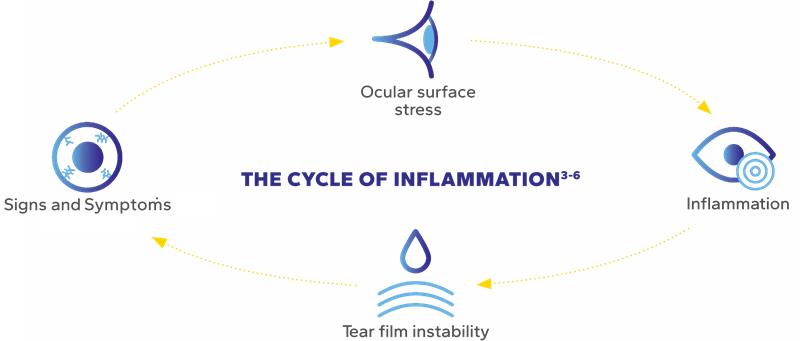
THE ROLE OF INFLAMMATION IN DRY EYE DISEASE
Dry Eye Disease is a multifactorial disease of the tears and ocular surface2
SOME OF THE MOST COMMON SIGNS & SYMPTOMS INCLUDE:
Redness
Ocular Pain
Sandy, gritty, foreign body sensation
Stinging, burning or eye pressure
Blurry Vision
Dryness7
SOME OF THE MOST COMMON RISK FACTORS INCLUDE:
References: 1. Caffery B, et al. Prevalence of dry eye disease in Ontario, Canada: A population-based survey. Ocul Surf. 2019;17(3):526-531. 2. Craig JP, et al. TFOS DEWS II Definition and Classification Report. Ocul Surf. 2017;15(3):276-283. 3. Stern ME, et al. Dry eye: an immune-based inflammation. In: Dartt DA, Bex P, D’Amore P, Dana R, McLoon LK, Niederkorn JY, eds. Ocular Periphery and Disorders. San Diego, CA: Academic Press. 2010:381–389. 4. Pflugfelder SC, et al. T helper cytokines in dry eye disease. Exp Eye Res. 2013;117. 5. Stevenson W, et al. Dry eye disease: an immune-mediated ocular surface disorder. Arch Ophthalmol. 2012;130(1):90–100. 6. Stern ME, et al. Dry eye as a mucosal autoimmune disease. Int Rev Immunol. 2013;32(1):19–41. 7. Golden MI, et al. Dry Eye Syndrome. StatsPearls [Internet]. Treasure Island (FL): StatPearls Publishing. 2025.